The Framework
The Intra-Synthesis Framework (IS)
The Intra-Synthesis Framework (IS) addresses two major unresolved challenges in science: the hard problem of consciousness and the persistent anomalies observed in Unidentified Anomalous Phenomena (UAP).
Mainstream science operates under materialism and positivism, which treat matter and spacetime as fundamental while viewing consciousness as a secondary byproduct. These paradigms, while successful in many domains, struggle to explain both subjective experience and the full range of UAP characteristics, such as extreme kinematics, observer effects, and apparent consciousness interaction.
Rather than pursuing a single isolated hypothesis, IS offers a two-layer synthesis: an ontological layer in which consciousness (mind) is primary and fundamental, and a physical layer that operates as a coherent, emergent subset within that ontological ground. This structure regards the material world as the rendered output of recursive self-observation by mind.
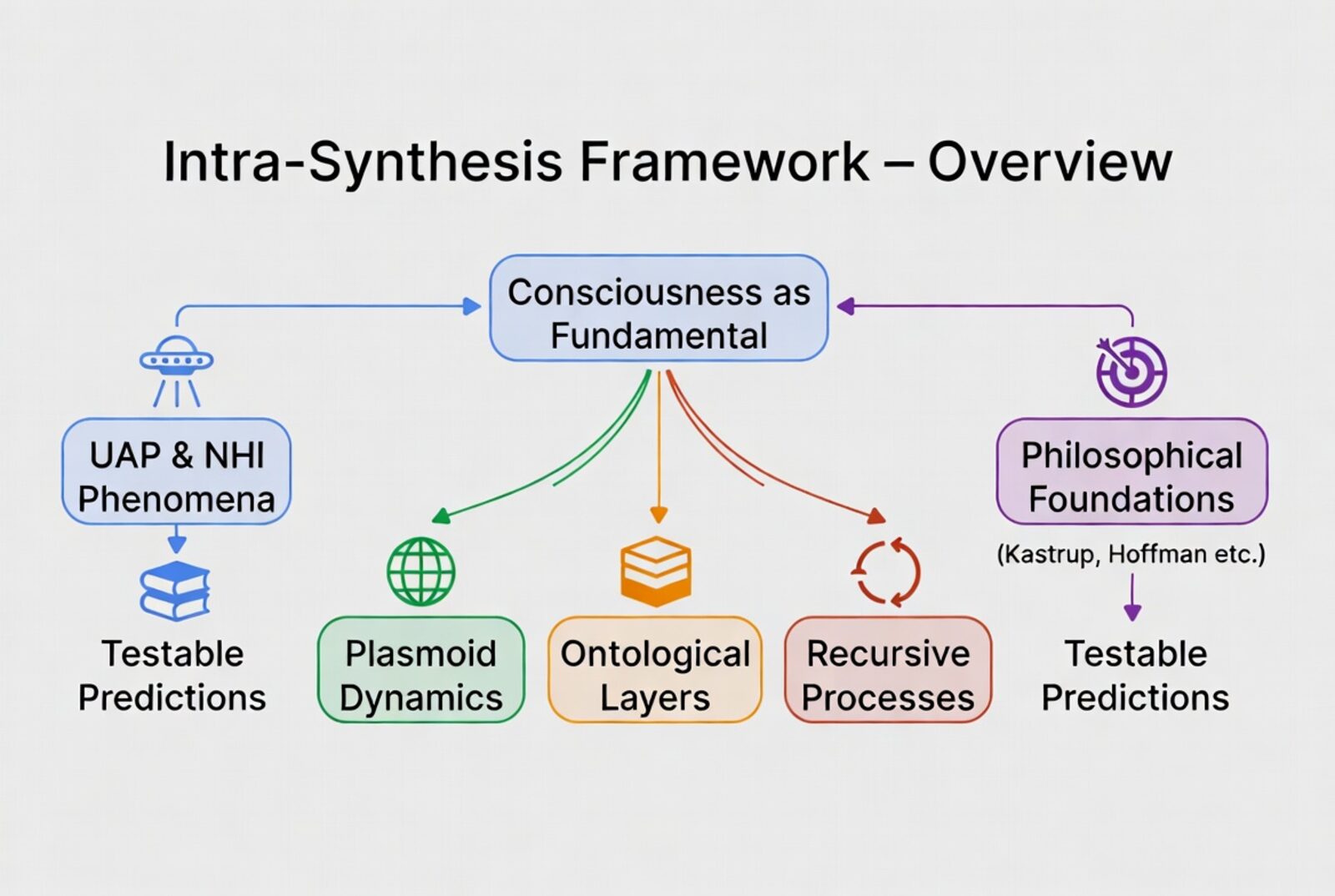
The Two Layers
Ontological Layer — Modified Self-Simulation Hypothesis
Reality is understood as a genuine self-simulation: a strange-loop process in which mind observes and thereby renders itself. There is no external programmer or hardware.
The modification is ontological. Klee Irwin's original self-simulation hypothesis is informationalist: an abstract, code-theoretic substrate simulates itself, and consciousness emerges from that self-referential computation. IS inverts the substrate. Mind (consciousness) is primary, and the self-simulating, strange-loop architecture is what mind does to render the appearance of a physical world. Same recursive geometry, idealist foundation instead of an informational one.
This view builds upon analytic idealism (Bernardo Kastrup), conscious realism (Donald Hoffman), biocentricity (Robert Lanza), and the self-simulation hypothesis (Klee Irwin). Physical laws and spacetime emerge consistently from this recursive process, preserving empirical regularity without causal redundancy.
Physical Layer — Unified Classical Resonance Cosmology (UCRC) & Resonant Plasmoids
Within the mind-generated domain, physics remains fully classical and lawful. The framework incorporates Unified Classical Resonance Cosmology (UCRC) developed by Tobie Venne and collaborators.
This scale-invariant, wave-mechanical model explains many UAP manifestations, particularly resonant plasmoids, through plasma physics, zero-point energy rectification, and environmental interactions, without requiring exotic new physics.
Mind–Physics Interaction
The two layers interact through recursive self-observation (strange loop). The physical layer functions as the stable, observable “rendered” domain emerging from the deeper ontological ground of mind.
The Two-Layer Ontology and the Physicality of UAP
In the Intra-Synthesis Framework (IS), reality is structured in (at least) two integrated layers. The ontological / metaphysical layer is primary: consciousness/mind is fundamental, and physical spacetime, matter, and the classical laws of physics emerge as a lawful, consistent subset through recursive self-observation (a modified self-simulation process). This layer addresses the hard problem of consciousness and explains why observer effects appear in UAP reports.
The physical / emergent layer is secondary and rendered. Once the ontological layer generates the shared ruleset, a stable, intersubjective "rendered" reality appears for all observers who participate in the collective consensus. Within this second layer the universe behaves according to classical physics — as described in the Unified Classical Resonance Cosmology and resonant plasmoid dynamics. Objects, forces, and events here have real physical properties: mass, inertia, electromagnetic signatures, radar returns, thermal effects, and the ability to interact with the environment and multiple independent sensors.
UAP are best understood as natural boundary effects that occur at the interface between the ontological (mind-generated) layer and the physical (rendered) layer. They can — and often do — manifest as physical objects within the shared, rendered reality of the second layer. They are not hallucinations, purely subjective visions, or non-physical apparitions; when they appear, they can be detected on radar, infrared, and optical sensors, and can produce measurable environmental effects such as electromagnetic interference and physical traces.
Their extreme performance characteristics — instant acceleration, transmedium travel without sonic booms, apparent violation of inertia — arise because they are not bound solely by the constraints of the emergent physical layer. They retain a direct connection to the deeper ontological processes, allowing "leaks" or boundary behaviors that look anomalous from within the classical ruleset.
The shared, collective aspect matters: because the physical layer is a collectively rendered consensus reality, multiple unrelated witnesses and instruments can observe the same UAP event consistently, even though the phenomenon ultimately originates from a more fundamental mind-based process. UAP are thus both "mind-related" in their ultimate origin and observer-dependent qualities, and genuinely physical objects when they appear in our everyday shared world. This framework avoids the false dichotomy of "either fully material extraterrestrial craft or purely psychological/illusory." UAP straddle the boundary in a lawful way.
Concrete cases illustrate how the second (rendered) layer registers UAP as fully physical, while the boundary behaviors point back to the deeper ontological layer:
- Radar returns
- USS Princeton AN/SPY-1 tracks of the Nimitz "Tic-Tac" (2004) recorded discrete objects descending from ~28,000 m to sea level in under a second — an instrumented physical signature on a hardened military sensor, with reconstructed lower-bound accelerations ≥ 5,370 g (Knuth, Powell & Reali, 2019). The radar return is real second-layer physics; the kinematics are the boundary leak.
- Sources
- Infrared / electro-optical imagery
- The U.S. Navy FLIR1, GIMBAL and GoFast videos (declassified 2017–2020) show thermal contrast and EO tracking locks on solid objects — confirming heat signature and optical reflectivity in the rendered layer, while the rotation, lack of exhaust plume, and motion against wind point to non-classical dynamics.
- Sources
- Electromagnetic interference
- The 1976 Tehran incident (DIA report, F-4 Phantom intercept) involved repeated loss of weapons, communication and navigation systems on two aircraft as they closed on the object — a measurable EM effect on multiple independent platforms, fully physical in the second layer.
- Sources
- Thermal & ground effects
- The Trans-en-Provence case (1981, GEPAN/CNES investigation) left calcined soil, altered iron-oxide content and stressed plant biochemistry at the landing site — persistent material traces analyzed in laboratory. Likewise the Delphos, Kansas (1971) ring showed long-lasting soil hydrophobicity. These are second-layer physical residues of a boundary event.
- Sources
- Multi-witness, multi-sensor consensus
- The Belgian wave (1989–1990) combined ground witnesses, police reports, F-16 onboard radar locks and ground radar tracks of a triangular object — the same event rendered consistently across unrelated observers and instruments, exactly what the collective-consensus second layer predicts.
- Sources
- Material samples
- Stanford / Garry Nolan's analyses of recovered UAP-associated materials report anomalous Mg / Si / B isotopic ratios (Nolan, Vallée, Jiang & Lemke, 2021) — physically real matter measurable by mass spectrometry, yet with composition not produced by known terrestrial processes.
- Sources
- Observer-side biological signatures
- Preliminary basal-ganglia connectivity findings in close-proximity experiencers (Nolan et al., Stanford / FREE) and the broader pattern of post-encounter neurological and perceptual changes are the mind-side fingerprint of the same boundary event whose physical side leaves the radar and material traces above.
- Sources
In each case the evidence is dual: instruments and bodies record real, repeatable physical effects (second layer), while the anomalous performance, perceptual qualities, and observer effects point to the first (ontological) layer. Neither side alone suffices.
Implications for UAP
IS reframes the effects associated with UAP encounters — including their physical traces — as natural boundary phenomena or resonant interactions within a consciousness-driven reality, rather than violations of incomplete physical laws or necessarily external interventions. This integrated view offers greater explanatory power and internal consistency.
Advantages of the Framework
- Avoids the explanatory failures of strict materialism.
- Maintains a testable, classical physical layer.
- Eliminates the need for external simulators or unfalsifiable claims.
- Provides a coherent bridge between consciousness studies and physics.
- Allows fair, transparent comparison with other UAP hypotheses.
Addressing Common Criticisms
This is not another unfalsifiable "we live in a computer simulation" argument. Unlike Bostrom-style proposals, the Intra-Synthesis Framework describes a genuine self-simulation: reality arises from mind observing itself, eliminating the need for an external programmer or hardware. It avoids causal redundancy and remains fully compatible with empirical science by preserving a lawful, testable classical physical layer.
While critics may view consciousness-first models as speculative, materialism itself carries heavy explanatory burdens: it cannot account for the origin of consciousness, the measurement problem in quantum mechanics, the fine-tuning of physical laws, nor the full spectrum of well-documented UAP characteristics.
IS addresses these gaps through a clean two-layer integration:
- A rigorous ontological foundation. Mind as primary, aligned with Analytic Idealism, Conscious Realism, Biocentricity, and the Self-Simulation Hypothesis.
- A coherent classical physical description. Via Unified Classical Resonance Cosmology (UCRC) and resonant plasmoid physics.
The framework maintains a neutral, citation-rich evidence base and openly compares IS with other major UAP hypotheses, Extraterrestrial Technological (ETH), Ultra-Terrestrial / Cryptoterrestrial, Breakaway Human, and Hybrid models, against the same data. We invite rigorous scrutiny, falsification attempts, and collaboration. Genuine progress requires examining our deepest assumptions about reality.
A Call for Intellectual Courage
Materialism has dominated for over a century, yet the anomalies continue to accumulate and the debts of explanation keep growing. Searching for single-hypothesis solutions while ignoring the clear need for ontological and physical synthesis is increasingly untenable.
The Intra-Synthesis Framework offers a more rigorous and parsimonious path forward: mind as primary, physics as its lawful emergent subset.
Invitation
This framework is a living research project. We welcome rigorous scrutiny, critique, falsification attempts, and collaboration. A neutral evidence base and comparative analyses with other major hypotheses (ETH, Ultra-Terrestrial, Breakaway Human, Hybrid) are maintained on this site to support transparent inquiry.